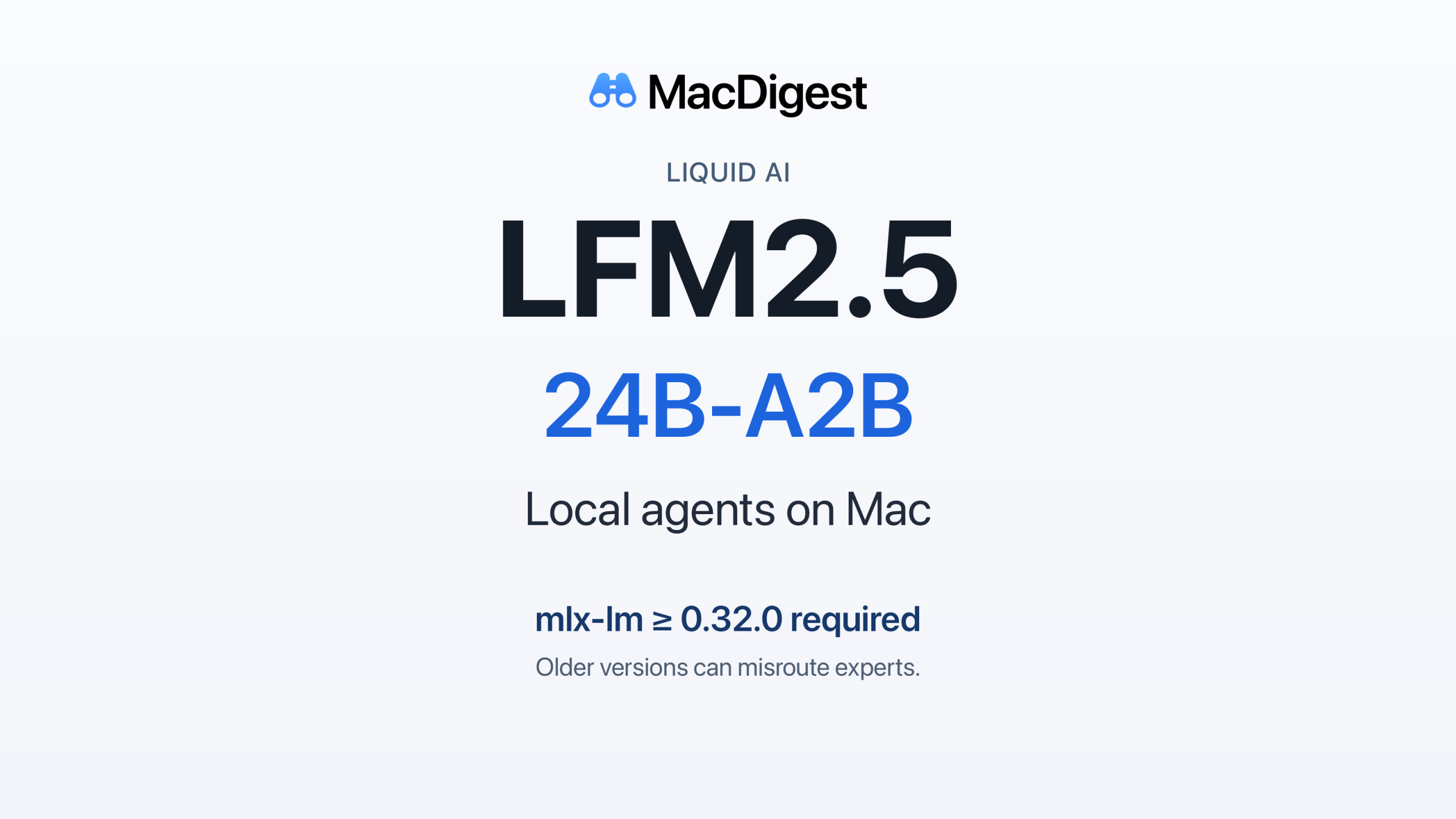
Liquid AI released LFM2.5-24B-A2B on October 13, bringing another open-weight reasoning model to developers building local agents on Apple silicon. It supports tool calling and ships with an official MLX version. Before evaluating that version on a Mac, check one dependency: mlx-lm must be version 0.32.0 or later. [1, 3]
Check the runtime first
The official 4-bit MLX model card warns that earlier mlx-lm versions can load the model while routing its experts incorrectly. A successful launch alone therefore cannot establish that an older installation is running it correctly. Verify the version in the environment your app actually uses before judging the model’s answers. If a Mac app bundles its own runtime, check that app’s compatibility notes rather than assuming a separate Python update covers it. [3]
Liquid positions this release for agents that reason and call tools. A host application must provide tools, execute permitted calls and return their results. For knowledge-heavy work, its model card recommends pairing it with retrieval or web search. Local inference still requires attention to privacy: connected tools and remote services may send data off-device. [2]
Plan for the full model
The mixture-of-experts model contains 24 billion parameters, with 2.45 billion active per token. That active count describes parameters used per token; memory planning must also account for the resident weights, context, runtime and macOS. [2]
The official 4-bit MLX weight files total approximately 13.57 GB to download. That is a file-size figure, not a guaranteed RAM requirement or a promise that any particular Mac configuration will run comfortably. Leave headroom for your applications and the agent’s working context. [4]
Supported context grows to 131,072 tokens, compared with 32,768 in LFM2-24B-A2B. That gives longer conversations and tool results more room, although developers still need to measure memory use and responsiveness at their intended context length. [2, 6]
Read the deployment limits
Liquid reports 184 tokens per second on an M5 Max using llama.cpp, Q4_K_M quantization and a 4K-token input. This is a vendor decoding measurement, not an MLX benchmark, independent replication or end-to-end agent timing. MacDigest has not tested the model. [2]
The LFM Open License v1.0 includes a $10 million annual-revenue threshold for commercial use. Developers should review the full license and its definition of Legal Entity before commercial deployment. [5]