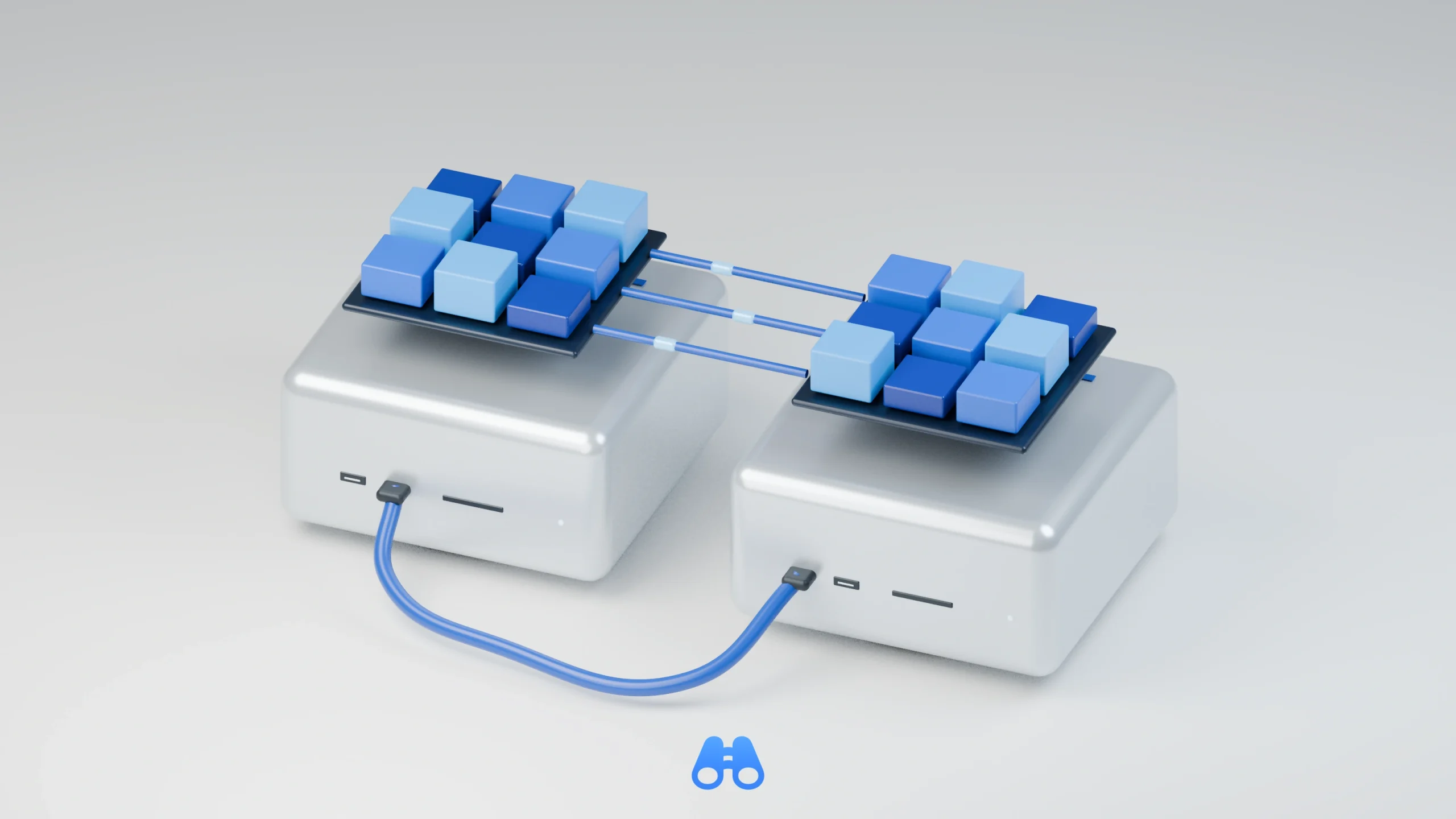
Conceptual illustration of two generic silver desktop computers, symbolic blue tile banks and connecting blue links, representing a distributed model. Illustration: MacDigest.
Meta has released Muse Spark Open, an open-weight multimodal model aimed at coding and agentic work. Its 816 billion parameters include 42 billion active at a time, and Meta advertises a one-million-token context window. For Mac developers, the hardware is a notable part of the October 15 announcement: two M5 Ultra Mac Studios, each configured with 512GB of unified memory, running the model through MLX. Meta’s announcement.
Why two 512GB Macs are needed
The model’s native BF16 parameters alone require over 1.6TB of memory, Apple says. Lower-precision NVFP4 cuts the model footprint to about 493GB, but inference overhead rules out a single 512GB Mac Studio. Apple’s research.
That distinction matters when reading the model’s specifications: the active-parameter count describes how much of the model participates at a time. It should not be mistaken for the total model size. Meta’s announcement.
Availability also needs a date attached. Apple’s August announcement scheduled the 512GB Mac Studio configuration for late October. As of October 15, readers should not assume that this particular configuration is already shipping. Apple’s availability announcement.
Two ways to divide inference
Pipeline parallelism places successive groups of layers on different Macs: the first machine processes its layers and passes the result onward. Tensor parallelism divides work within layers across machines, which must exchange results during computation. Apple’s research.
The connection between those machines matters. MLX’s distributed documentation describes JACCL, a communication backend using remote direct memory access (RDMA) over Thunderbolt 5 for low-latency transfers. Its supported topology requires a direct cable connection between every pair of participating Macs. The documentation also says enabling RDMA requires macOS Recovery, so this is a configured multi-machine setup rather than simply connecting two computers and opening an app. MLX documentation.
Read the benchmark in context
Apple reports these decode speeds with 8,192 context tokens and 128 generated tokens, using M5 Ultra Mac Studios and NVFP4: Apple’s research.
| Configuration | Decode speed (tokens per second) |
|---|---|
| 2 Macs, pipeline | 15.74 |
| 2 Macs, tensor | 24.99 |
| 4 Macs, tensor | 36.73 |
These are Apple’s measurements, not MacDigest’s tests. They do not demonstrate performance at the advertised one-million-token context limit. There is no single-Mac Muse result because the model does not fit. Apple’s research.
The release also needs a licensing distinction. Meta describes the Muse Model License as having limited commercial terms. Open-weight availability should not be treated as unrestricted open-source licensing. Anyone planning to redistribute the weights or ship them in a product needs to review the actual license for that use. Meta’s announcement.
For developers, the useful takeaway is a way to explore larger models locally. Memory capacity, communication setup and a workload-specific evaluation all belong in that assessment; a headline tokens-per-second figure cannot settle it alone.