Apple’s October 13 “Welcome home” event could give its smart-home products a more connected role across the house. The reported lineup includes a new display, an updated HomePod mini, and a new Apple TV 4K. Together, they raise a bigger question: can Apple make a shared home feel as straightforward to use as a personal device?
Our earlier preview focused on three questions for buyers. This guide adds the latest reporting and a bingo card to follow as announcements arrive. Every product prediction below remains unconfirmed.
What Apple has actually confirmed
Greg Joswiak’s teaser gives the date, October 13, and the “Welcome home” tagline. An invitation shared by Marques Brownlee places an Apple Experience in Tribeca, New York, at 9 a.m. Eastern: 6 a.m. Pacific, 13:00 UTC, and 9 p.m. in China.
That is the invitation’s time for attendees. At the time of writing, Apple’s Events page does not list an October 13 livestream. Keep an eye on Apple Newsroom and Apple’s official channels; an in-person start time does not establish the exact timing or format of online announcements.
The display could set the direction
Bloomberg’s Mark Gurman reportedly calls the new home display “HomeView.” 9to5Mac’s October 11 account describes tabletop and wall-mounted versions, an A18 chip, Apple apps, and a voice-led experience centered on Siri. It also reports no dedicated App Store. The HomeView name and these details still await Apple’s confirmation.
Household recognition is also reported: the display could change its content depending on who approaches or speaks. A demonstration should make clear whose information is visible and how people switch profiles.
Placement matters. A countertop screen needs to be readable while someone cooks or walks past; a wall-mounted device needs a practical installation story. Touch controls also need to remain useful when speaking aloud is inconvenient.
The reported software, provisionally called homeOS, combines familiar ideas such as widgets, clocks, photos, and Apple apps. Reporting on its interface points to Siri as the main interaction method. Watch for an actual household task demonstrated from start to finish. A useful demonstration would show how a spoken request, an on-screen control, and a connected accessory work together.
Apple TV and HomePod mini have different jobs
The existing Apple TV 4K specifications still list an A15 Bionic chip. Thread networking is specified for the Wi-Fi + Ethernet version, a useful reminder that connectivity can differ within the same product family.
For the next model, Gurman’s reporting as summarized by 9to5Mac says Apple has tested microphones in the box and a speaker in the remote. “Tested” leaves room for features to change or miss the shipping product. Buyers should look for confirmed capabilities before treating either as an upgrade reason.
A refreshed HomePod mini could bring the new assistant into rooms without a display. The latest reporting points to an S10 chip, Siri AI, and new colors. The useful comparison will include supported requests and how the speaker works alongside existing devices.
The reported schedule is staggered: October 30 for Apple TV and HomePod mini, around mid-November for HomeView. Those are reported release targets, not confirmed ordering dates.
The accessories could make the difference
Code findings reported by 9to5Mac point to partner accessories associated with LG and Schneider. A product reference in software does not establish retail availability.
Apple already lets HomePod and Apple TV act as home hubs. Any new partner program therefore needs to explain its benefits for homes with accessories already installed. Easier setup, understandable controls, and clear compatibility information would make the wider pitch more useful.
Play along: Welcome Home Bingo
Use the card in reading order. “Reported” means an idea appears in pre-launch reporting. “Watch for” marks an editorial question. Neither label confirms an announcement.
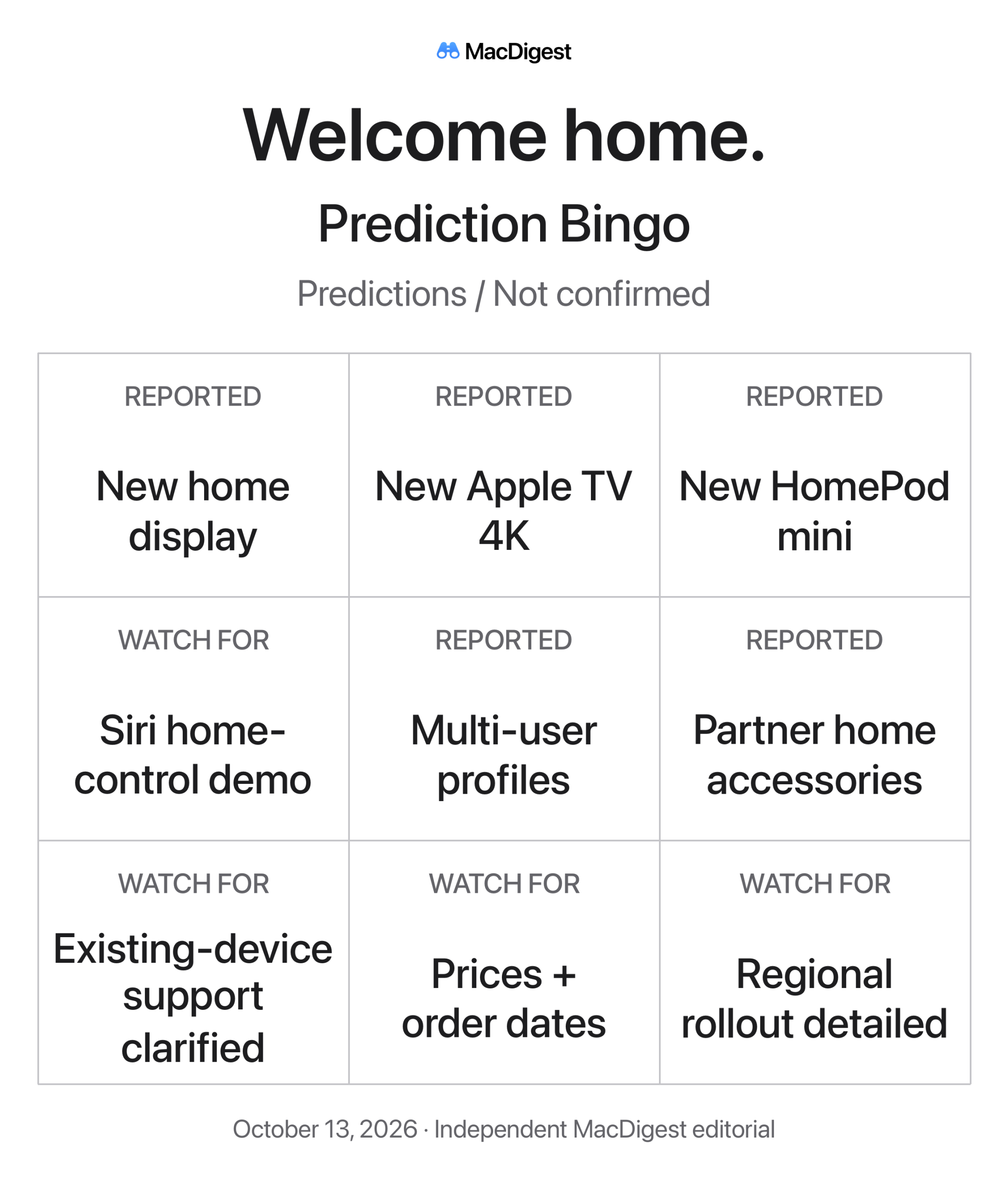
- New home display — Reported. Apple officially introduces a new home-focused display. A mention of an existing iPad does not count.
- New Apple TV 4K — Reported. Apple officially introduces a new Apple TV 4K hardware model. A tvOS-only update does not count.
- New HomePod mini — Reported. Apple officially introduces refreshed HomePod mini hardware.
- Siri home-control demo — Watch for. Apple demonstrates Siri controlling a connected home accessory in the announced experience. A general AI claim alone does not count.
- Multi-user profiles — Reported. Apple explicitly describes or demonstrates person-specific profiles or recognition for the new home display.
- Partner home accessories — Reported. Apple names at least one new partner home accessory or accessory lineup. A generic compatibility logo alone does not count.
- Existing-device support clarified — Watch for. Apple documents whether a new home capability works with an existing device family, including explicit exclusions. Silence leaves the square unmarked.
- Prices + order dates — Watch for. At least one announced product has both an official price and an ordering date. A shipping month alone does not count.
- Regional rollout detailed — Watch for. Apple identifies launch markets and availability details for at least one announced product. A demonstration language alone does not count.
Mark a square only when Apple explicitly announces or demonstrates it, or documents it on an official product or support page. For prices and ordering, require both. For regional rollout, require named markets and availability details. There is no free square; three across, down, or diagonally makes bingo.
The final score should leave readers with a clearer picture of what Apple announced, what works together, and what remains unanswered.
Cover: Apple invitation artwork via Marques Brownlee. Bingo: MacDigest. Independent editorial work.