
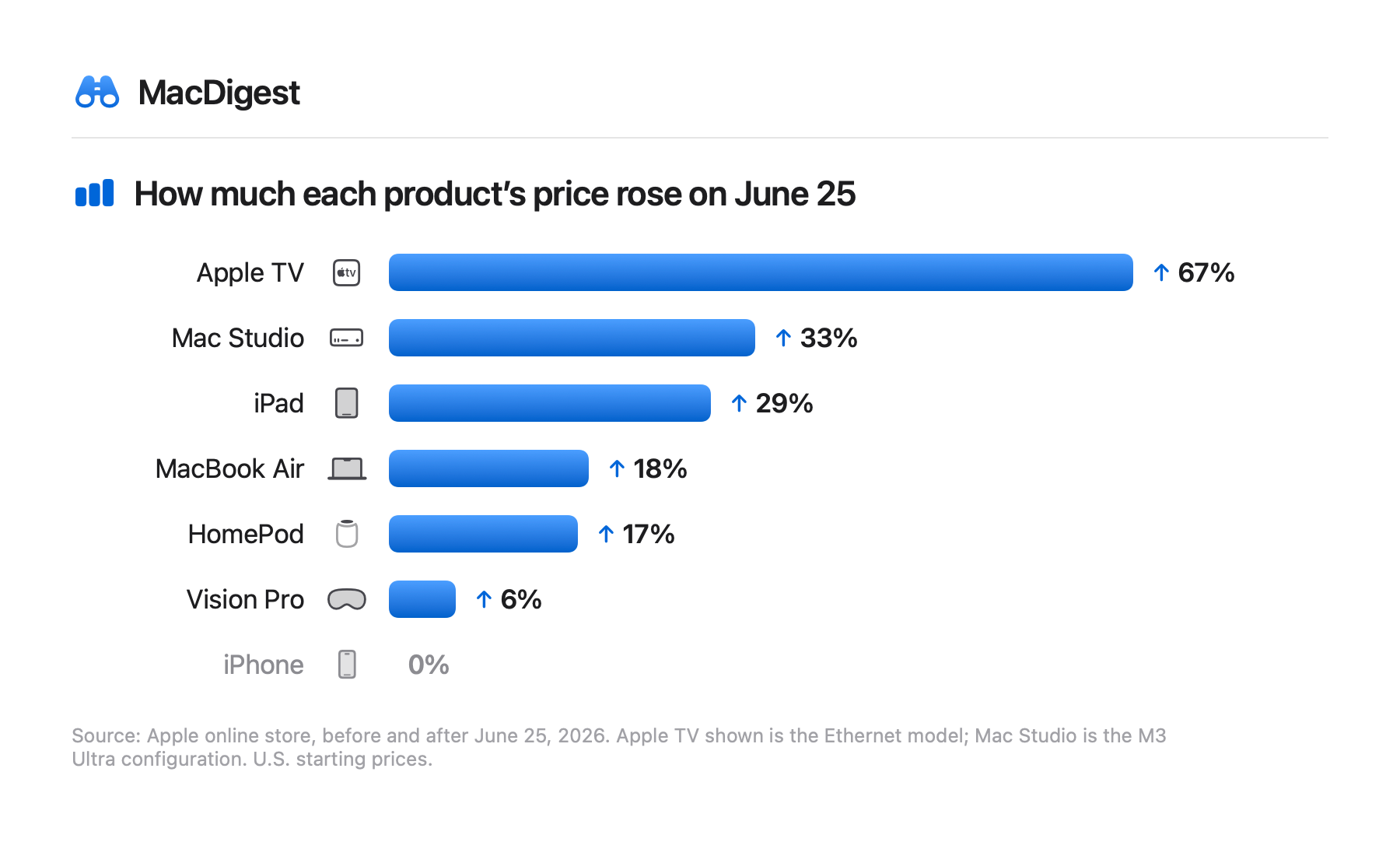
On June 25, Apple’s online store went down for a few hours and came back with higher prices across the lineup: every Mac, every iPad, the Apple TV, both HomePods, and the Vision Pro.
Everyone has covered the price list. Here’s what it actually means.
Apple explained itself
Apple almost never gives a reason for its prices. This time it did. In a statement, it said AI data centers are buying up the world’s memory, and that component prices have never risen this fast. A week earlier, Tim Cook called the shortage a “hundred-year flood” in The Wall Street Journal.
For twenty years, Apple charged what it decided a product was worth. Now it charges what the memory market forces. The AI firms buying up DRAM set the price of a MacBook Air this summer, not Cupertino.
The math doesn’t add up
A MacBook Air has 16GB of memory and 256GB of storage, which cost Apple a few dozen dollars before the surge. Double that and you add maybe $40 to $60. Apple raised the price $200.
The Mac Studio with M3 Ultra ships with 96GB of memory. Double that bill and you add a few hundred dollars. Apple raised the price $1,300, a 33 percent jump on a machine that didn’t change.
These are estimates. Apple buys memory years ahead at prices nobody outside knows. But the gap is too big to pin on components alone.
There’s a way to check, and it has a date. Apple reports earnings on July 30. If the increases just cover costs, gross margin holds around 47 to 48 percent as guided. If margin climbs while prices stay high, the flood was also an umbrella.
Unified memory presented its bill
Apple Silicon runs on unified memory: RAM soldered onto the processor package, non-upgradeable. It’s a fast design with one catch. Every Mac ships with its full lifetime of RAM on day one, paid for by Apple at the factory. A PC maker ships lean and lets you add sticks later. Apple can’t, so its exposure to memory prices is total and immediate.
For a decade that worked in Apple’s favor. Memory was cheap, Apple bought it cheaper, then charged $200 to move up a tier. Now the commodity market has climbed to the prices Apple was already charging, and the base configs, where Apple eats the memory cost itself, are the most exposed line on the bill. The biggest hike went to the machine with the most memory on the package.

1999 made the opposite call
In October 1999, Motorola couldn’t make the 500MHz G4 chip in volume, so Apple couldn’t ship the Power Mac it had just announced. It reconfigured the line: every tier dropped 50MHz, prices stayed put. The 450MHz machine took over the 500’s $3,499 price. Buyers got a slower computer for the same money. The press called it the speed dump, probably the first time in PC history that performance dropped without the price following.
Back then, Apple cut the specs and held the price. This year it held the specs and raised the price. In 1999 Apple was fighting for buyers. In 2026 the installed base is captive, and Apple will charge loyalists more before it lets a benchmark slip.
The bottom rung took the hit
This doesn’t hurt people buying $5,299 workstations. It hurts lower down.
The $599 Mac mini is gone, and a Mac desktop now starts at $799. The MacBook Neo, launched in March at $599 to open a cheaper door into the Mac, costs $699 a quarter later. The entry iPad, the classroom tablet and most people’s first Apple device, went from $349 to $449, up 29 percent.
Apple spent a decade building that lower staircase: the cheap iPad, the budget mini, the Neo. In one morning, every step rose. These buyers aren’t upgrading a Studio. They’re deciding whether to buy their first Apple device at all.
The iPhone was left alone for now. New iPhones arrive in September, where a higher price reads as the cost of a new model. Expect the increase to land there.
What to watch
July 30 shows whether this was cost recovery or margin harvest. September brings the iPhone 18’s price, the most uncertain number in Apple retail right now. Nobody credible expects memory relief before late 2027, so don’t wait for a rollback.
If you’re buying: third-party retailers haven’t caught up, and last-generation hardware still sells below Apple’s new floor. That won’t last. Buy what you need, and don’t hold out for March’s prices. They’re not coming back.
MacDigest is an independent publication with no affiliation to Apple Inc. Component-cost figures are editorial estimates; Apple's supply terms are not public. U.S. prices as of publication. Verify at apple.com before purchasing.